Fixed items
- Business registration: low double-digit amount, depending on the municipality
- Permit under § 11 TierSchG: fee varies by veterinary office
- Police certificate of good conduct
- Business liability insurance: ongoing premium
Professionally, most founders have long been ready. What holds them up is the order: which permit first, which registration when, which insurance actually covers you. This page sorts that out.
The order isn't a suggestion: you may not start without the permit under § 11 TierSchG, and it takes the longest.
Before registering anything: how will you prove your expertise? A completed training or further education course with an exam is the easiest route. Without one, you prepare for the expert interview at the veterinary office.
In writing to the responsible veterinary office. Expect up to four months of processing time, extendable by two months. This is the longest item in the schedule – start with it, don't leave it until last.
Schools with a fixed location need escape-proof fencing, injury-free equipment, shelter from the weather and water. If you work on the move, you don't need a fixed ground – which significantly lowers start-up costs.
At your local trade office. The registration is automatically forwarded to the tax office, the Chamber of Commerce (IHK) and the responsible employers' liability insurance association.
You submit the tax registration questionnaire via ELSTER. This is also where you decide on the small business rule under § 19 UStG – it saves VAT paperwork but rules out input tax deduction.
Business liability insurance that explicitly includes the care of other people's dogs. Without this, the policy is worthless when it matters.
Which courses, which group sizes, which hourly rate? Anyone who estimates here instead of calculating often works below their value for years.
A website with your town in the title, a Google Business Profile, listings in dog school directories. People search for “dog school” plus the name of their town – that's where you need to show up.
Four months of processing time is the norm, not the exception. Anyone who plans course starts and advertising before the decision arrives ends up postponing both.
Normal business liability insurance without cover for other people's animals won't pay if a customer's dog causes or suffers damage during training.
Anyone who bases their group price on the competitor next door instead of their own costs only notices the mistake after the first tax assessment.
Terms of participation, liability rules, cancellation deadlines and compulsory vaccination belong before the first session – not in the discussion afterwards.
A list works up to about thirty customers. After that, every week costs hours that are missing from training.
Large groups look like more revenue, but they lower training quality and therefore referrals – a dog school's most important source of customers.
The mandatory items are manageable. What gets expensive is what you spend on training, ground and equipment.
Your trade office and veterinary office will tell you the exact fees – they differ from municipality to municipality. How to get from your running costs to an hourly price is explained under Calculating prices.
Note: This page provides general guidance and is no substitute for legal or tax advice. Responsibilities, fees and requirements differ depending on the federal state and municipality.
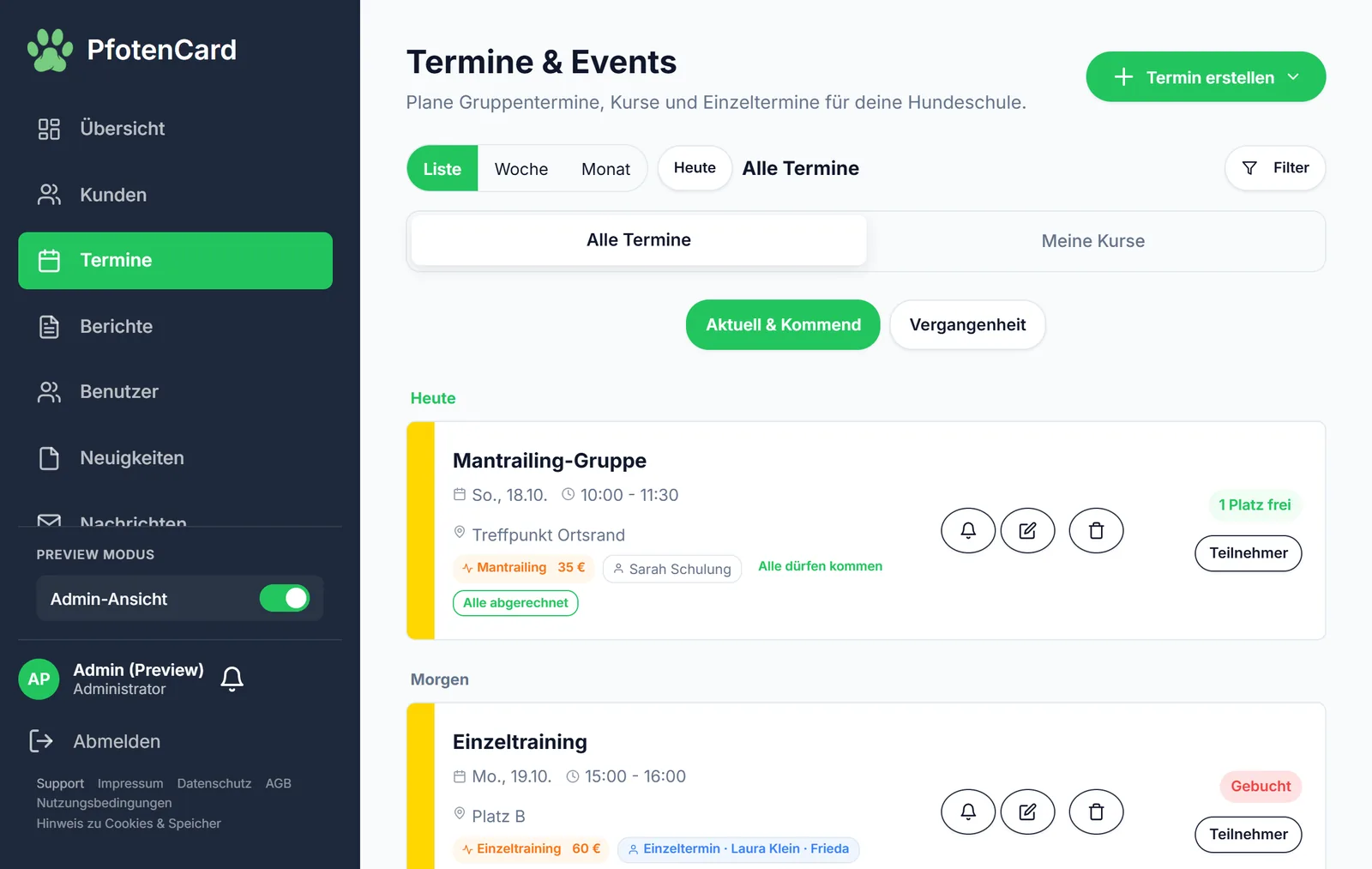
Customer records, dog records, appointments, credit and invoices in one place – apply for beta access.