Guides

Calculate your prices instead of guessing

Most dog schools base their price on the competitor next door. The result is an industry in which many work below their value and only notice at the end of the year. This page shows how to calculate from your target income to a robust hourly price.

  • From annual target to hourly rate in four steps
  • Why sellable hours and working hours aren't the same
  • All cost blocks that belong in the calculation
  • When a price increase is due
By the PfotenCard editorial team (Joos Soft Solutions) · Published on · Last updated on

The calculation in four steps

Work backwards, from your target to the price. Anything else leads to numbers that feel good but don't hold up.

  1. Set your annual target

    What do you want to earn before tax? Add health insurance, pension provision and a reserve for lost income. That's the amount your business has to generate before any costs are even covered.

  2. Add up operating costs

    Ground, insurance, equipment, software, travel costs, further training, tax adviser. Work with annual figures – monthly amounts tempt you to forget items.

  3. Determine sellable hours

    Not your working time, but the time someone pays for. Subtract holidays, illness, weather cancellations, travel time, preparation, communication and accounting. What's left is usually considerably less than half.

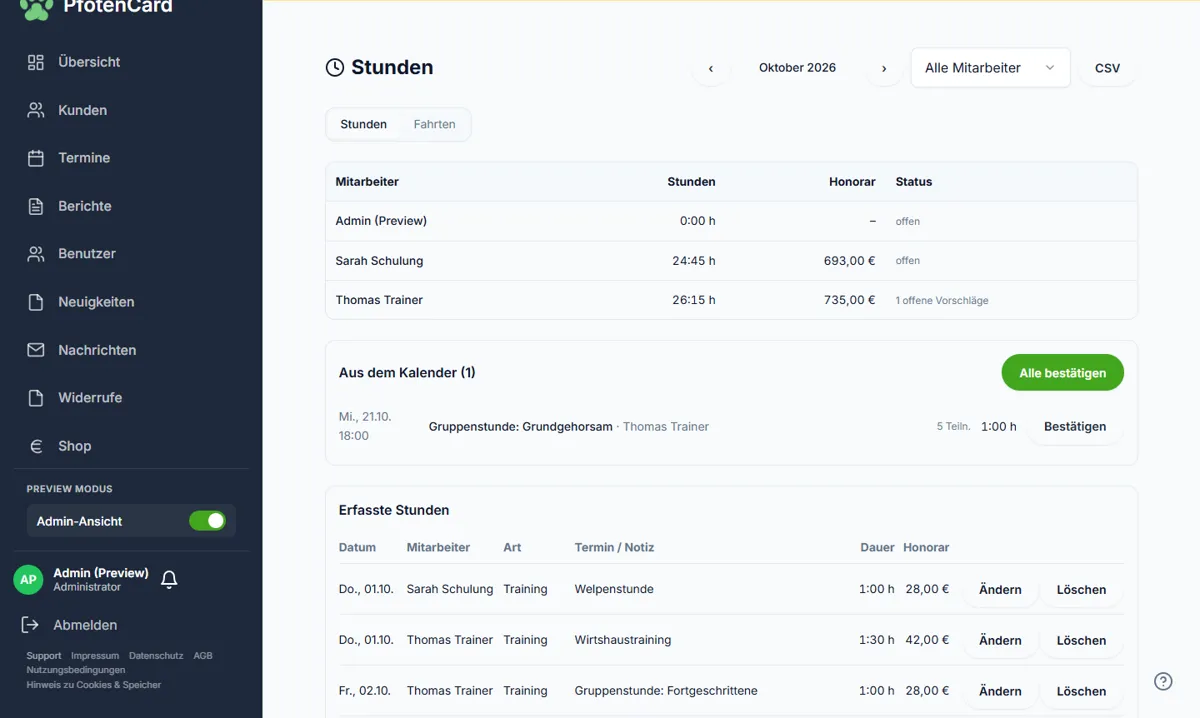
    Time tracking per staff member in PfotenCard
    This is how it looks in PfotenCard
  4. Divide and cross-check

    Annual target plus costs divided by sellable hours gives your minimum hourly rate. If it's far above what's usual in your region, you need larger groups, a specialisation or a different offering – not a lower price.

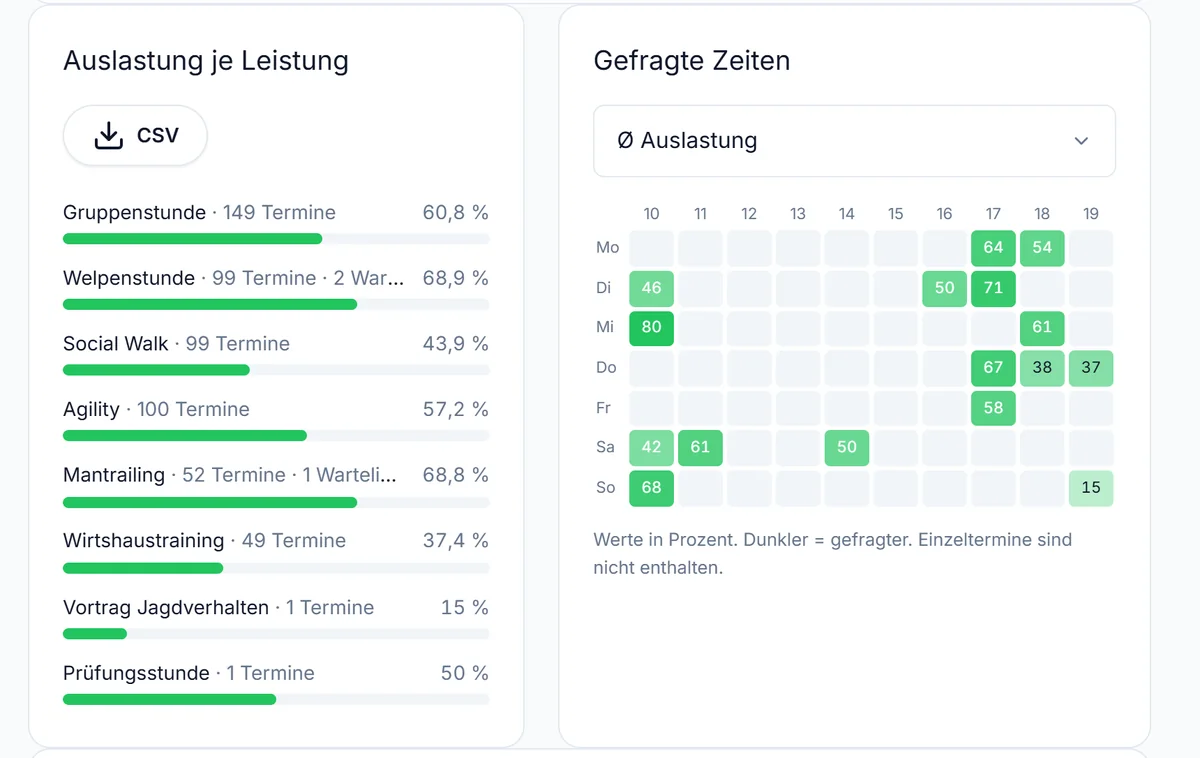
    Course occupancy in the PfotenCard statistics
    This is how it looks in PfotenCard

A worked example

Suppose you want to earn 36,000 euros before tax and have 12,000 euros of operating costs a year. Together that's 48,000 euros. With 20 sellable training hours per week and 44 working weeks, you arrive at 880 hours – which means each hour has to bring in around 55 euros.

In a group of six participants, that's just over 9 euros per person per hour – and that's before anything is allowed for cancellations, bonus credit or payment fees. This is exactly where you see whether your group size and your price fit together.

These cost blocks belong in the calculation

Forgotten items are the reason a calculation works on paper but not in your bank account.

  • Ground and premises

    Lease or rent, fencing, weather shelter, electricity and water, maintenance. When working on the move, vehicle and mileage instead.

  • Insurance and provision

    Business liability insurance covering other people's animals, employers' liability insurance association, health insurance and pension. For the self-employed, the most underestimated item.

  • Equipment

    Long lines, leads, hurdles, tunnels, dummies, first-aid supplies. Much of it wears out and has to be replaced regularly.

  • Running costs

    Website, management software, accounting or tax adviser, phone, bank charges, payment fees for card payments.

  • Further training

    Seminars, specialist literature, association membership. Not a luxury, but a prerequisite for keeping your expertise up to date.

  • Visibility

    Website, photos, printed materials, occasional ads. Predictable and usually lower than founders expect.

Keeping group and private prices apart

Group class

Your hour is spread across several paying customers. The price per person is lower, but your revenue per hour is higher – as long as the group is full. That's exactly why a waiting list that moves up automatically when people cancel is worth hard cash.

Private training

The full hourly rate falls on one person. In return, there's no occupancy risk, and you can work on issues that don't work in a group – fear, aggression, separation anxiety. Include travel time here too if you drive to customers.

How to keep credit, bonus rules and billing cleanly separate without your accounting suffering is explained under Managing your dog school.

Frequently asked questions about pricing

How do I calculate my hourly rate as a dog trainer?
Work backwards. Take your desired annual income before tax, add all operating costs and your own insurance and pension contributions. Divide the total by the hours you can actually sell – not by the hours you work. That difference is the most common pricing mistake in the industry.
How many hours can I realistically sell?
Considerably fewer than a full-time week would suggest. Travel time, preparation, customer communication, accounting, further training and acquisition are work, but not paid training time. Depending on how you work, 40 to 60 per cent of working time can be sold. Use the lower value if you're just starting out.
What does a dog training session usually cost?
As a rough guide: in Germany, group classes are usually in the middle to upper double digits per participant, private training considerably more. The range is wide and depends heavily on region, specialisation and group size. Use such figures as a sanity check for your own calculation – not as its basis.
Why is a group class cheaper than private training?
Because your time is spread across several paying customers. A group class with six participants at 20 euros per person brings in the same revenue as a private session for 120 euros. The effort per hour is similar, but the risk is different: if someone in the group drops out, you only lose part of the revenue.
Are credit packages worth it instead of billing individually?
Usually yes, for two reasons: you get the money in advance, which makes cash flow predictable, and customers with credit demonstrably come more regularly. It's important to keep bonus credit from promotions separate from real revenue in your accounts – otherwise you report income that was never received.
When should I raise my prices?
If you're regularly fully booked and keep a waiting list, your price is too low. In our experience, a ten per cent increase loses fewer customers than most people fear – and it affects the most price-sensitive first, not the most loyal. Announce it in advance and don't raise prices retroactively for running courses.
Note: The amounts given are worked examples to illustrate the method, not market statistics and not a price recommendation. For the tax side of your calculation, please consult a tax adviser.

A calculation is only as good as the numbers behind it

With cleanly recorded attendance, credit and revenue, you'll see at the end of the year whether the calculation worked out.